
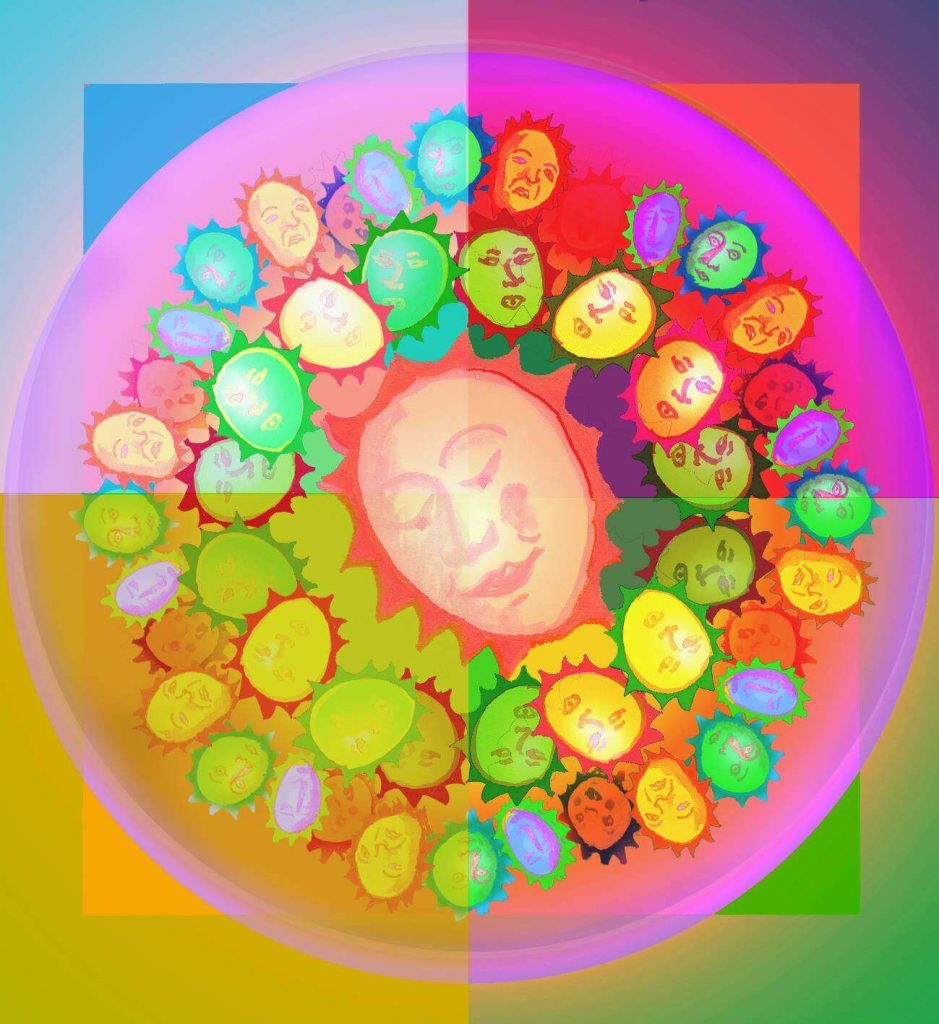
We Are One and Many
Anyone who explores the human psyche is aware that human beings are not made of a single, solid element. We are sometimes intelligent and sometimes foolish, we can be successful and unsuccessful, strong and weak, sensitive and insensitive. From the point of view of Voice Dialogue, not only are we not homogeneous beings, but within each and every one of us live countless inner-selves or parts.
Each inner-self has its own personality, characteristics, needs, desires, sensitivities, world-view and sometimes even a unique ideology. Each inner-self perceives and experiences the world in its own unique way, and each self has a unique gift to offer us – if we are open to receive it.
The inner-selves within us include mature and sober parts as well as inner children. There are within us inner-selves that are vulnerable and others that are tough. There are feminine and masculine selves, careful and adventurous selves and kind and antagonistic ones. Within us live conformists and anarchists, outsiders as well as conventional selves, spiritual guides, accountants, witches, critics, rebels and adventurers.
Passengers Asleep on a Bus
This inner diversity is neither a problem nor is it pathological. It is, from the point of view of Voice Dialogue, the normal state of affairs. That it is normal does not, however, imply that it works well. In fact, for most humans some inner chaos, conflict and turmoil are the common state of being, and this affects each and every aspect of our lives.
As long as we do not undertake deeper inquiry, we are unaware of the many inner-selves naturally residing within us, and live in bewilderment and unconsciousness, as if we were asleep. Things seem to happen to us without us having true awareness of what is transpiring or an ability to affect it. We think we are driving our lives, when in fact we are passengers asleep on a bus. We believe we are directing and managing our lives and making free choices, while actually being driven by a variety of automatic and unconscious responses originating from our various inner-selves, all of whom have needs, opinions and interests of their own.
Resolving Inner Conflict and Drama
Working with our inner-selves allows us to gradually get to know the different characters of our inner drama. This awareness has many profound and happy consequences, some of which we will address here.
Once we are skilled in giving expression to our inner-selves, they can appear clearly and vividly ‘on stage’, without the interference of other inner-selves. Thus each self is seen and experienced in all its glory: each has its own body language, voice, facial expressions, vocabulary and a unique energetic ‘frequency’ often accompanied by a distinct physical sensation.
When an inner-self appears in a clear way, and other selves do not prevent it from expressing itself, we are allowing full expression to one of many essences within us. At its best, an inner-self would be one-sided and narrow and might even resemble a caricature. For this reason, working with inner-selves can sometimes be not only moving, heartwarming and profound but also extremely funny. Laughing fondly with our inner-selves allows us to accept and embrace even the most challenging of them, and quickly raises our awareness of the sometimes surprising ‘actors’ operating within us.
The Dominance of ‘the Management’ Over the Disowned Selves
We can classify our inner-selves in more than one way. In this text I will mention only one of them: ‘managing and controlling selves’ and ‘disowned selves’.
Our managing selves manage us mainly in order to protect us or, more specifically, to protect our sensitivity, our delicate and often wounded core. To this end, they take control during our early childhood and do everything in their power to prevent us from being hurt, to ensure that we succeed and to make a good impression, according to their own particular worldview. This worldview – which is influenced by cultural, family, genetic factors and our own personal history – is what will determine which inner-selves will be disowned, (since they are perceived as endangering us), and which will be strengthened.
The managing inner-selves do indeed assist us in surviving physically and emotionally, but we pay a heavy price for our identification with them and their methods of survival. From a very young age, many valuable selves within us are disowned and pushed away. We might, for example, lose the sensitive child (our main pathway to love and intimacy), the assertive self, the leader, or any other inner-self, according to the ideals and fears of our inner-management. As these selves are disowned, we lose abilities, talents and diverse ways of experiencing the world and interacting with it.
In other words, we might survive and even succeed in life, but at the cost of losing important ‘organs’ of our psyche, without which we cannot be whole. This ongoing denial causes a host of hardships: meaninglessness, hopelessness, depression, anxiety, difficulties in relationships and sexuality, health issues, and more.
One of the main goals of this work is, therefore, to gradually return to being whole and aware of all our selves, embracing them all without being identified with any of them. Luckily, even a self which was disowned and repressed for many years does not ‘die’ but is relegated to the ‘basements’ of our unconscious from where it struggles to return to our awareness.
This unconscious struggle of disowned selves to return to our awareness causes tremendous conscious and unconscious pain, anxiety and rage. This too gradually resolves as more and more inner-selves find their place within us.
The Management
The Big Boss
At the head of the Management one often finds the big boss, a self that can be called the Protector-Controller or The Manager. This inner-self mainly deals with protecting our basic vulnerability. He watches us with constant vigilance but rationally (in his opinion), and does his best to prevent us from doing anything that endangers us (according to his perception). It is very important to him (or her) that we succeed (according to his standards), and he is, therefore, very busy hiding things within us that he perceives as embarrassing or negative, in order to create the right impression (in his view) on those around us (so that they don’t judge us and endanger our vulnerability).
It’s all a Facade
Here is a short excerpt from a dialogue with Tamara’s inner Manager, demonstrating the importance that such inner-parts place on making the right impression, and the terrible price we pay when we identify with them and allow them to run our lives:
Facilitator: May I speak to Tamara’s Manager?
Tamara moves to another chair, which helps her experience the fact that we are now speaking to a self within her and not to Tamara as a whole.
Manager: Hello. I’m glad you asked to speak with me again.
Facilitator: It’s nice to see you again. Can you tell me more about the way you manage Tamara’s life?
Manager: Look, Tamara needs to adapt herself to any setting. If there’s a need to be strong, she should be strong. If she needs to be weak, she should be weak. I’m like a chameleon. I adapt her to any situation.
Facilitator: That’s interesting! So, if you are constantly adjusting her to each situation, is there anything real?
Manager: No. It’s all a facade. Actually she’s nothing. In the end, nothing’s left.
Facilitator: How did it happen?
Manager: It happened because I had to save her. I saved her and now she despises me! She thought it would be better if she didn’t exist, but I’ve been keeping a very close eye on her since she was three years old. I made sure she was always a super good girl. When she was little, she wasn’t allowed to make any noise. She had to learn how to behave very early on.
Facilitator: And today?
Manager: Today, no one must find out that she feels like she’s nothing. It takes so much energy for me to keep it hidden. And in no way should she lose control.
Tamara’s Manager was very strong and his influence on her life was especially crushing. She felt artificial, cut off from herself and from life. Yet even when the Manager’s effect on us is less tragic than it was in Tamara’s case, we all have managers and other inner selves that limit our freedom to be ourselves and our ability to fulfill our potential. As long as we are not aware of their actions and natures, they continue to manage our lives according to their narrow world views.
Through a patient and caring process, we can learn to accept our Managers and any other inner-self, for that matter, for who they are, without identifying with them. This allows us to enjoy the Manager’s skills without suffering from the dire results of his (or her) exclusive Management.
From Conflict and to Harmony
Working with inner-selves has deep impacts which can only be suggested here, but it is important to mention that in time, all members of what I humorously refer to as the Management can become our allies. This takes time and work but it is wonderful to see how the conflict between the selves in our Management and the previously disowned, even hated, selves, can settle down into a comfortable working community as the entire inner system begins to function harmoniously.
Who Else is On the Board of Managers?
Each person’s Management is unique. Selves that are disowned in one person can sit proudly in another’s Management. Still, there are a few inner selves that are quite commonly found on the managing board of many modern people:
The Critic is the self who criticizes everything about us. He can, for example, tell a pretty woman: “You’re disgusting”. If you don’t do liposuction from your thighs, there’s no way anyone will ever want you”. After we do as the critic says, there is a good chance he will then say that “now your thighs are too skinny and not in proportion to the rest of your body”, or, “only spineless people are affected by criticism”. In short, as long as we heed whatever the Critic says, we will always feel unworthy, and if the Critic is particularly harsh, we may simply despair of ourselves and our lives.
To a Perfectionist, it is clear that we are supposed to be nothing less than perfect. When she compares our miserable life to her lofty ideals, it is clear to us that who we are and what we have really doesn’t make the cut. For example, an outstanding Perfectionist can prevent us from studying painting for fear that we won’t be the next Rembrandt.
Despite their destructive potential, the Critic and the Perfectionist, (as with all inner-selves), also have their benefits, provided they do not control us.
They can, for example, drive us to achieve, or awaken us from a coma of excessive self-satisfaction. But, as long as we believe their every word, we will never feel whole nor will we be able to experience our essential value.
For many of us, another star sitting on our Management is the Pusher. With endless lists of things to do in one hand and a whip in the other, he (or she) pushes us to ceaseless action. When we are identified with him, we are haunted by a sense of pressure and misery and we find it difficult to just potter around, relax and simply be, because by virtue of his nature, he is simply unable to relax.
There are, of course, many other selves we can encounter within our Management team. Continuous and compassionate attention to what is happening in our lives, thoughts, sensations and feelings is required in order to set ourselves free from their tyrannical rule. This liberation occurs as a gradual process, and requires us to take our Management’s concerns into serious, respectful, even loving consideration. As this process unfolds, our disowned inner-selves also find their place in our lives in a safe, responsible way.
Disowned Inner Selves Rise from ‘the Basement’
One can gradually get to know many disowned selves – each one fascinating and vital for our wellbeing in its own way. If we have a Lazy Bum in our Management, we might have disowned and locked over-achievers and doers in our dusty, airless basement. If we have doers in our Management, we may discover lazy selves crying in the dark.
There are also inner-parts who, although they may never have been actively disowned, never had the opportunity to surface into our awareness due to the noisy civil wars raging within us. These types of inner-selves can include, for example, spiritual guides and other selves who specialize in different nuances of being, creation and observation.
The Inner Children
Unfortunately, many of us have disowned our inner children, each of whom are priceless. For example, when the magical children are present in our lives, the world becomes rich, magical and fascinating. The cheerful, playful children bring joy, vitality and simplicity to our lives. They love to play, dance and sing, be idle and do only what they truly feel like doing. When they are disowned or disliked, our life loses its spark, its joy, but when they are cherished, we are happy and alive.
In order to restore the blessed influence of the disowned children to our lives, we must discover who are the managing selves whose interests are served by keeping them out of the picture. Often, after having a conversation with such a managing self and allowing it to become clear and distinct, the disowned, suffocating child can emerge.
For this to work well, we must understand both the fears regarding the resurfacing of the child (The Manager may fear, for example, that we will be seen as childish or stupid), and also the benefits and importance of bringing this child back into our lives. With this awareness, we can choose whether to embrace this child or continue to disown her and pay the price for doing so.
Sensitive Inner Children
We also have sensitive, gentle and vulnerable children living within us, the main representatives of everything in us that is delicate, soft and little. When we are aware of them and they are loved and taken care of, they allow us to experience warmth, true friendship, love and intimacy, and they bring with them sensitivity and heartfelt beauty. When they are neglected and denied a place within us (which is often the case), we become emotionally sealed off and tough or feel victimized and wounded. We may also experience difficulties in maintaining healthy relationships.
As we have already mentioned, the main purpose of our managing selves is to protect our vulnerability, that is, mainly our vulnerable children. The sensitive inner-children, then, are at the heart of our emotional system. As long as we do not take care of them and accept them and their pain, our managing selves will do it for us in their automatic and insensitive way. And because our managing inner-selves are far from being suitable caretakers for delicate children, we will continue to be in pain, lonely or shut off. However, when we learn to love and listen to them, our emotional system can finally calm down and allow the Management to relax as well. Ella’s story demonstrates something of this process:
Ella’s Sensitive Child
“Even though there have been many successes with my project lately, I am disappointed”, said Ella, at the beginning of our meeting. “Everyone has defined roles, and only I, who manage the whole thing, do not. It’s as if my work is transparent. So when everyone receives compliments and recognition, I feel as if my part in the success goes unrecognized.”
We decided to invite the inner-self within Ella who felt disappointed. Here is an excerpt from the conversation:
Facilitator: May I speak to the self in Ella who felt disappointed when others received more recognition than she did?
The sensitive, vulnerable girl appeared and Ella’s eyes were flooded with tears.
Facilitator: (gently): What do you feel?
The Girl: I feel like I’m being ignored, like I’m completely transparent and unimportant. Everything can go on without me and I’m not needed at all.
Facilitator: How does your body feel right now?
The Girl: It feels very uncomfortable. It’s like I’m blushing from the inside.
Facilitator: And what did you think and feel when everyone received recognition and Ella less so?
The Girl: I felt ashamed to admit that I want them to say what should be said about her.
Facilitator: If Ella hadn’t stopped you, what would you have done?
Girl: I would cry. The cry of a broken heart and of disappointment, not of anger. Now my tears are stuck in my throat. It’s sore. Maybe it’s what happens when you don’t say what you feel.
Facilitator: Maybe. You can cry now, you know.
The Girl: Maybe I’m the outcast. The one that got boycotted several times when she was little. Once, a new girl came to the neighborhood. She said she was the Includer and Excluder, and she excluded Ella. After that, for months nobody spoke to Ella, and everyone thought she was guilty of doing something, but she wasn’t guilty of anything!
Facilitator: Ella is listening to us now. Is there anything you want her to know? The Girl: I want her to make sure that people don’t say the wrong things about her! I want her to make sure that people say the right things about her!
The conversation with the vulnerable, outcast child had joyful consequences. Her disappointment and pain received full and accurate expression, (although the girl had difficulty crying), and the inner child was acknowledged. The previously abstract and vague feeling was given a distinct face and presence so that it could be understood and supported. Furthermore, during the conversation, Ella stopped identifying with the girl’s feelings and was able to examine whether she truly did not receive recognition or whether, from the girl’s point of view, she simply did not experience it.
After the conversation, Ella felt – without any effort on her part – recognised. By allowing her to speak freely, she herself gave recognition to her excluded, outcast child. And because the subject stopped bothering her, she felt empowered and freer. This is not to say that the vulnerable girl will not appear again, but when she does, there is a good chance that Ella will be able to address her distress in a more constructive way.
The Aware I
The purpose of this work, therefore, is to become increasingly aware of our inner-selves; to recognize the legitimacy and importance of each of them; to befriend them, but not to get swallowed up by them. Thus, through a patient and committed process, the management of our lives gradually transfers from ‘the Management’ to what can be called our ‘Aware I’.
Unlike the Management, the Aware I is not a self. It is a state of consciousness and a process from which one can learn to navigate one’s life in a very practical way. It has a broad perspective and an ability to balance the different selves and their various needs. For those who do their work faithfully, a wonderful and mysterious center at the heart of our emotional and psychic system is discovered and created, where we are paradoxically both all and none of our inner-selves.
The Aware I (Dr Hal Stone and Dr Sidra Stone use the term The Aware Ego), is the center of the entire process of Voice Dialogue. Without nourishing this ongoing state, through ups and downs, twists and turns, we enjoy only a small portion of the possible benefits of this practical, profound, effective and safe approach.
Basics of the Work
The best way to work with inner selves is to speak to two opposing selves one after the other. For example, with the Pleaser (another common management member) who only wants us to do what suits others, and then with the Egoist, who only cares about our own interests. Working with opposing selves experientially sharpens the awareness that no inner-self is ‘us’ and that we can always find within ourselves an opposing self to the one with which we are currently identified.
When we succeed in accepting the contradictions within us, we have the option to choose: is it right for us to consider others right now, or is it best for us to take care of our own needs at this particular time? Or perhaps there’s some combination of the two which would work best? The ability to embrace our inner polarity empowers and frees us. It allows us to express the whole that we are in all its shades, colors and textures.
No Judgment
When talking to inner selves, it is important not to be critical towards them. Selves, like humans, flourish when they feel accepted and that we are genuinely interested in what they have to say. They shut down, and are offended or aggressive when they feel criticized. If, for example, there is criticism towards a lazy self, it is vital to find out which inner-self is criticizing it. It could be, for example, an ambitious self who, for as long as we are identified with her energy, blocks our possibility of accepting and expressing the lazy self.
Awakening, Flowering, Spreading Wings
For many, working with the inner selves is an effective and safe way to deal with crises and conflicts, and to reach solutions to various difficulties. But at its best, it allows a process of awakening, a gradual opening up, like a flower, slowly revealing all of its petals, its wholeness. It bears its finest fruits when it is done over time, gradually, with patience, courage, dedication, determination, curiosity, fond humor and without knowing in advance what will be revealed to us.
I Am All That Is
There are many stories about the night Buddha experienced his awakening. According to one of them, that night, after years of unsuccessful attempts, Buddha was determined to succeed. Mara, the king of demons, saw this, and sent him thousands of selves: demons and monsters, his beautiful, seductive daughters, lazy, greedy selves and many more.
Buddha sat meditating with great determination, as these selves swarmed around him and attacked him, doing their best to distract him and prevent his awakening.
After many troubled days, Budha finally realized: I am the demons. I am the temptations. I am all the selves. In that moment, he experienced an awakening.
Safety and Responsibility
Voice Dialogue has very efficient safety measures built in, which cannot be addressed in an article of this length, but they are very important for maintaining the stability and safety of the process. It is a complex yet simple and effective method, well worth studying and experiencing. Reading this text can only provide a first taste of this approach and all its intricacies and depths. It is advisable to do much deep inner work with our own inner-selves before working with others.
Origins of the Work
Voice Dialogue was first developed in the 1970’s by Dr Sidra Stone and Dr Hal Stone.
There are books on the subject by Hal and Sidra Stone as well as by others, and there is my own book in Hebrew, The Demon, the Nun and the Magical Child – A Journey to the Selves Within Us, (2006) which I hope will soon be translated into English. There are sites and facilitators – some naturally better than others – you can easily find.
Please also see ‘Voice Dialogue in Short’ on this site.
It is permitted and desirable to quote and use this text, with a clear indication of the author’s name and source of the quote.